Showing posts with label *Metal. Show all posts
Tuesday, September 4, 2012
Like Rats - Like Rats (2012)
My goal for Like Rats is to create music that could have existed in the evolving extreme metal scene of the late 1980s and early 1990s. Many of the bands that are ostensibly related in defining genre parameters don't really sound much like each other. Morbid Angel sounds way different than Suffocation sounds way different than Deicide etc.
I wanted to write with the same feelimg as early material from Incantation, Immolation, Darkthrone, and Asphyx without actually sounding too much like any of those bands. I also wanted to maintain the punkish d-beat feel of Celtic Frost and Sodom (who just very clearly loved Discharge and Motörhead). Finally, I wanted to stress the dark melodicism that defines early death metal as well as artists like Dead Can Dance, Prokofiev & Strauss. Speaking of Strauss, trying to touch what these people have done makes me feel like an ape encountering a monolith, but such is life.
Here is a track-by-track breakdown with all of the riffs I can remember purposefully stealing. Some are blatant rip-offs and others are a bit more abstracted. I've noticed other acts of thievery upon relistening to the album, but these are the ones that were definitely intentional. Click each link to be taken to a youtube video timestamped to the pilfered riff.
Red Dawn:
Celtic Frost - Innocence & Wrath
Morpheus Descends - Proclaimed Creator
Fire:
Slayer - Piece by Piece
Death Strike - Pervert
River Dread:
Immolation - Into Everlasting Fire
Morbid Angel - Chapel of Ghouls
Winter Sun:
Sergei Prokofiev - Piano Sonata No. 6
Unleashed - The Final Silence
Massacra - Apocalyptic Warrior
Dark Masks:
Krypts - Dormant of the Ancients
Darkthrone - Summer of the Diabolical Holocaust
Dusk:
Sepultura - Morbid Visions
Celtic Frost - Eternal Summer
Direction:
Gorgoroth - Drommer om Dod
Sodom - Nuctemeron
Bloodline:
Sergei Prokofiev - Piano Concerto No. 2
Celtic Frost - Procreation of the Wicked (probably the single most influential riff on Like Rats)
Russian Midnight:
Richard Strauss - Also Sprach Zarathustra
Incantation - Nocturnal Dominium
And of course, here are external links for purchasing and listening:
Full album stream via Decibel
Vinyl via A389 Recordings
Digital download via A389 or iTunes
Monday, August 20, 2012
Negativa - Negativa EP (2006)
I'm resurrecting Primitive Future to post this EP, which I've been listening to extensively since I saw Gorguts a month or so back. Obscura is one of my all-time favorite albums, and this EP basically just sounds like Obscura. I also exchanged myspace messages with Big Steeve sometime around 2005 probably, and it blew my mind that someone from one of my favorite bands would take the time to respond to me on the internet. I actually think I just told him the story about my mom buying me a copy of Obscura then immediately making me turn it off when I put it on in the car.
Either way, the riffs on this record are truly strange. One of the most compelling things about Gorguts and Negativa is that, while their riffs are ostensibly nonsensical, they are immediately memorable. If you heard someone playing one of these riffs in Guitar Center devoid of context, you would be irritated and confused. Yet, as part of these songs, they're almost hummable.
Negativa also manages to be heavy in a bizarre, lurching way. Their riffs are occasionally bouncy, but still off-kilter. I know this band was working on a full-length, but unfortunately Big Steeve passed away a few months back.
RIP, Big Steeve.
Tuesday, June 12, 2012
Karl Sanders Interview
This new record is awesome. By the
way.
The new what
record? The new Nile record? [laughs] Just wanted to clarify which
record we're talking about. I'm sure there's a lot of new records out
there.
There's plenty of new records out
there. Not sure if any of them are good, but this Nile record is
fantastic. Since you were just practicing, that's actually one of the questions I was going to
start off with. On this new album, the lead playing seems to have
been really taken up a notch, so I was going to ask what you actually
do to practice.
Usually my routine
starts pretty early in the day. I get up and start working with the
metronome. Basic scales and arpeggios. I start off really slow with
the metronome, then I gradually work my way up in tempo.
After a few hours
of that insanity, it's onto new ideas. I'll work on new ideas for
different melodic things or different techniques or maybe something
I'm learning. I have a pile of instructional DVDs. Anything from Mike
Stern to Paul Gilbert to Rusty Cooley to Jeff Loomis to Jeff
Beck...I've been quite fond of that one lately.
Then, I might work
on some new riff ideas for some songs. By that time, I'm pretty well
warmed up and my hands can follow along with whatever my brain might
come up with.
So basically playing guitar is a
full-time job for you.
Yeah, especially
in the last couple years. I had taken quite a bit of abuse on the
internet based upon a stupid-ass video that...I should have taken
more seriously. We were so completely exhausted on the Ozzfest tour
that we just did not have the energy to dredge up the ability to give
a fuck.
That video, which
I got slammed for quite a bit, just really...It was really, really
psychologically crushing. I'm going to take all of this ill will that
people are throwing at me and turn it into a motivational iron will
to improve. So that's what I've been doing the last few years. Just
fucking working my ass off to push forward.
What are you
working on right now?
I'm doing four finger patterns in diatonic natural minor. In each
position, the four finger pattern changes so it takes a lot of
fucking concentration. I'm working on that, trying to be able to move
between the four different shapes. It's quite a challenge.
Do you do any
improvisational work in practicing?
Sometimes
after I'm finished with working on scales, I might just play
whatever. Just jamming
some blues with my kid and whatnot. That's fun. He's into...get
this...Albert King, Stevie Ray Vaughn, and Eric Clapton. My seventeen
year old kid...that's what he's into. Go figure!
Hey man, that
works out fine. Those are some hot licks there.
Obviously to progress you have to
continue to challenge yourself. Do you challenge yourself with other
people's ideas or with your own? Which do you find to be more
beneficial?
I think other
people's ideas are a jumping-off point. I might learn a Rusty Cooley
lick, but the next challenge is to make it your own. To take it
somewhere new melodically or to take the pattern and invert it...in
some way personalize it. That's really where I try to steer to. Even
if I learn something, I try to make it my own and take it someplace
that's a little personal.
In terms of actually composing these
Nile songs, where do these riffs come from? Are you humming melodies
to yourself? Are they coming out of licks that you practice?
On this record,
like I usually do, I write the lyrics first.
When it came to writing the riffs, I did it just a little bit differently. Every day, after I'd gotten warmed up with a bunch of technique and stuff, I'd sit with the guitar and the lyrics sheet and just start riffing. Sometimes I'd just leave the recorder on. I've got my cabinet in the next room with the mic on it that goes straight to a digital record. I'd just record every fucking single riff. And just try to not think about the fact that the red button was pushed. I'd say to myself, “If I don't like anything, I don't have to keep it.” And saying that to myself was liberating. I'd just play a gazillion riffs.
The next day, I'd sit down and sift through them. I had so many riffs for this fucking album. It was insane. You could make a couple of albums out of all of the riffs that got thrown out.
When it came to writing the riffs, I did it just a little bit differently. Every day, after I'd gotten warmed up with a bunch of technique and stuff, I'd sit with the guitar and the lyrics sheet and just start riffing. Sometimes I'd just leave the recorder on. I've got my cabinet in the next room with the mic on it that goes straight to a digital record. I'd just record every fucking single riff. And just try to not think about the fact that the red button was pushed. I'd say to myself, “If I don't like anything, I don't have to keep it.” And saying that to myself was liberating. I'd just play a gazillion riffs.
The next day, I'd sit down and sift through them. I had so many riffs for this fucking album. It was insane. You could make a couple of albums out of all of the riffs that got thrown out.
So you'd basically end up jamming
with yourself.
Yeah, I think so.
Always with the lyrics sheet around so that my mind was on whatever
the song happened to be talking about.
Nile obviously has a certain sound
based upon certain scales and modes. Are you conscious of the theory
behind this stuff while you're in your “jam sessions?” Or are you
just tuning out and going for it?
I find the most
beneficial things for me are to forget about the theory for awhile
and play. And then examine the theory afterwards. Or, to learn a new
scale and just see where it goes. Quite a bit of the leads just
happened to fall into this scale that I had just come across in the
last year called supraphrygian mode. It's like a phrygian mode, but
it has a flatted fourth. It's got a lot of unique fingerings and
pattern shapes that really worked well within some of the songs we
were writing.
Now that you have all of these riffs
is the arrangement a communal process? Or are you the one sifting
through everything and composing with what you have?
Usually if I'm the
one writing the song, I'm the one sifting through the riffs. If
Dallas is the one writing the song, he self-edits just as well. Then
we make song demos.
We record guitar,
bass, drums, vocals. We recorded every single thing that was going to
be part of the song. Down to the last iota. Especially with the
vocals this time. We wanted to get the vocal patterns and phrases and
melodies down there as soon as possible so that they could be under
the same sort of scrutiny as the guitar riffs were.
I actually noticed that. The vocals
on this record seem to be more intelligible and catchier.
I'd agree. I think
the process of scrutinizing them and refining them at an early stage
in the songwriting process really helped with that.
Just from a “fan” standpoint, I
was thinking, “These songs are much more distinct because the vocal
patterns are much more distinct from song to song.”
Also, how do you decide who songs?
There's things
that Dallas does really, really well. There's things that I like to
think that I can do. Usually it falls into...Dallas is really tight
rhythmically, and I usually slither
around the beat. Like odd phrasings.
One thing that happened while we were making these song demos...the very first song demo that we would make would be me recording all of the parts to be able to show it to the other band members. Then, the other band members would come and rerecord their parts. Those were always called the “Cave Box Demos.” I would sing in registers that I was thinking were for the other band members. Not necessarily the super low stuff that I do a lot. I ended up singing in more of an area that I thought would be ok for Dallas or Chris. Then Chris came to me and said, “Dude, you're fucking nuts! You're fucking crazy! This other voice you're using fucking sounds killer and we should be making use of this!” At first I was like, “What are you fucking crazy? These are just demos for me to show you guys your parts.” And Lollis [former bass player Chris Lollis] was like, “No man, this is an absolutely killer voice and we should make use of it.” So it turned out that we gave his idea a chance.
You hear some of that voice in track number two, “The Fiends Who Come to Steal the Magick of the Deceased,” the title track, “The Gods Who Light Up the Sky at the Gate of Sethu” and “Tribunal of the Dead.”
One thing that happened while we were making these song demos...the very first song demo that we would make would be me recording all of the parts to be able to show it to the other band members. Then, the other band members would come and rerecord their parts. Those were always called the “Cave Box Demos.” I would sing in registers that I was thinking were for the other band members. Not necessarily the super low stuff that I do a lot. I ended up singing in more of an area that I thought would be ok for Dallas or Chris. Then Chris came to me and said, “Dude, you're fucking nuts! You're fucking crazy! This other voice you're using fucking sounds killer and we should be making use of this!” At first I was like, “What are you fucking crazy? These are just demos for me to show you guys your parts.” And Lollis [former bass player Chris Lollis] was like, “No man, this is an absolutely killer voice and we should make use of it.” So it turned out that we gave his idea a chance.
You hear some of that voice in track number two, “The Fiends Who Come to Steal the Magick of the Deceased,” the title track, “The Gods Who Light Up the Sky at the Gate of Sethu” and “Tribunal of the Dead.”
I actually just
assumed that all of the different vocals were from the new bass
player.
In a lot of the European interviews I've been doing, they said that
to me when I told them that was me doing those parts. They're all
like, “No, that's not you! That's the new bass player!” And I'm
like, “You motherfuckers! The new bass player isn't even on the
fucking record, so shut the fuck up!” [laughs]
It sounds like
you guys have really tightened up the songwriting process for this
record.
Absolutely!
Is there
anything in particular that is an overarching goal that you're trying
to achieve with these songs?
Well, my first goal was to completely and utterly not do anything
we've ever done before in terms of song structures or time signatures
or tempo changes. I wanted absolutely every bit of it to be something
completely foreign to us. Which is kind of insane. About halfway
through the songwriting process George Kollias, our drummer, sent me
an e-mail. He said, “Karl, what the fuck are you doing? All these
fucking insane time signatures and tempo changes and fucking weird
fucking odd time riffs. Dude, please! You're killing me! Will you
please just write something like old Nile? Something simple and
classic, because you're driving me crazy with all of this shit.” So
I thought about it for awhile, and I was like, “There's some
reality to what he said.”
You can't go so far overboard that you lose the listeners. So I
rethought my approach a little bit and I toned it down and pulled it
back a little bit into the realm of the accessible. And I think he
was absolutely right about that, because I think the album definitely
benefits from the listenability factor. Listeners have to have
something to grab onto. It can't be so technical that you lose your
listeners.
I think that the
vocals are a big part of the listenability on the new record. The
vocal patterns from song to song differentiate the songs more than
I've experienced on past Nile records.
I really agree with that. Each one of these songs has its own vocal
approach. The rhythms and the melodies and the way the vocals fit
with the guitar patterns...each one, to my ears, has a unique and
distinct identity.
In terms of this
newer record, is there something you'd like to see happen with this
thing that hasn't happened in the past?
We want people to hear what we're doing. That was an absolutely
primary focus. We want to capture stuff cleanly enough that the
listener actually hears what we're doing. There's a saying that I've
been beating up everyone on this record with that was involved in the
making of it: If the audience didn't hear you do it, then you didn't
do it. It counts for nothing. As far as guitaring and drumming and
the bass playing and the vocals...if the listener doesn't hear it,
then you didn't do it! We've had struggles in the past...you might
play an awesome guitar riff or guitar lead, but, if for whatever
reason, it doesn't come across out of the speakers to the end
listener, then what good was it?
Another goal, and this was coming more from Neil Kernon. Neil came to
the rehearsals for the record, and he said, “Guys, one thing we're
going to really do is capture the fire and the feeling that you guys
have here in the rehearsal room and make that translate through the
recording process into the end product.” Because a lot of times
that shit gets lost somewhere along the way. You know, the fire that
the band has. Trying to record it, and you do it a thousand times to
get it perfect. Sometimes, somewhere along the way, you lose the
human element. That's one thing Neil really wanted to focus on this
time: retaining the human fire and the spirit.
In terms of
recording then, did you play the songs together or did you instrument
by instrument?
Well, we always do the drums first. That's done with scratch guitars
where Dalls or I will play along with George. We don't necessarily
keep those guitar tracks. They're just scratch guitar tracks. You get
the spirit of the thing going on in the recording.
Once we're satisfied with the drums, then we go about the process of
laying the keeper guitars on there. The real ones. And this time,
man, we took about a fucking month just trying to get that shit
nailed down as clean as we could.
Cool man, those
are the questions that I have for you.
[laughs]Well this was a goddamn fun interview! I'm glad to be talking
about fucking music, shit that is actually relevant to the fucking
record. I can't tell you, my friend, how many interviews I do that
have nothing to do with the motherfucking record, and it's so
frustrating.
Well yeah,
that's usually my attitude when I'm interviewing anybody. What do I
want to know? What do people usually ask other than about band name?
[mocking voice]What's your five favorite albums right now? What's in
your Discman? What's in your iPad?
And I'm like, “There's nothing in my iPad!”
I mean, I guess
I would be curious what you're listening to.
But yeah, as a
listener, when I hear something I'm like, “Man, that's cool. How
did these guys actually come up with this?” Especially for someone
like you who has been in this forever and is continually getting
better. You usually see the reverse.
You
know, I don't live like that. I'm playing metal because that's what I
want to do with my love. It's my passion. It is
my life. I didn't start playing metal just because told me it was
cool. No. this is something I've always wanted to do. Ever since I
was nine years old and I picked up a guitar, this is what I've wanted
to do with my life. Man, I'm always trying to learn. There's so many
amazing bands and so many amazing guitar players, and you never have
to stop learning. It's endless.
Tuesday, January 10, 2012
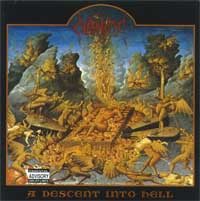
Cianide - A Descent Into Hell (1994)
I've been readinga few "best of" lists from 2011, and the only record that I've listened to with any consistency from 2011 is Cianide's Gods of Death. As such, I present you with one of Cianide's early achievements. This band has been basically putting out the same album since the early 1990s. This albums is a logical extrapolation of Hellhammer's Apocalyptic Raids as well as "Procreation of the Wicked." This is fully primitive, and fully cohesive. Support this band.
Monday, August 29, 2011
Cianide Interview
I interviewed legendary Chicago death metal outfit Cianide over at Invisible Oranges, so take a look ya turkey: Cianide interview
"We're just neanderthals. I'm cutting my lawn with a Venom shirt on, just sweating. Total neanderthal shit, man."
Their new record is also amazing, so consider enjoying that.
Thursday, April 28, 2011
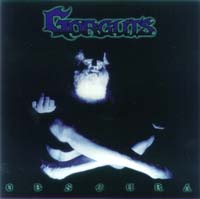
Gorguts - Obscura (1998)
This record is absolutely insane. So heavy. So weird. Consistently one of my favorite albums ever since that fateful day what must have been eight years ago.
Saturday, February 26, 2011
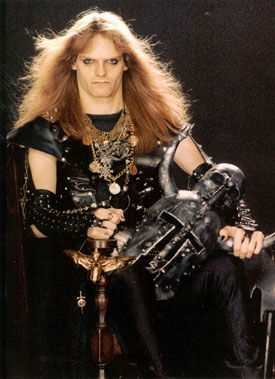
Tom Warrior Interview
--------------------------------------------------------------------------------
You’ve taken control of everything at this point. Having read your books, you’ve experienced some shady practices in the music industry. For the new Triptykon LP and this new EP, have you successfully navigated the treacherous waters of the music industry?
I would say yeah. We had the advantage of having a huge framework in place because of Celtic Frost’s last album. When we reformed Celtic Frost, we decided to keep control over everything. We formed a record company, Prowling Death Records, we formed our own music publishing company, and we put a framework in place of a manager and a combination of other things. When I left Celtic Frost, all of these people decided to come with me. I’m very happy about that, actually, and I was able to build Triptykon on the basis of that.
We retain control of everything. We have partnered with Century Media, which is a fantastic partnership. But, at the end of the day, we call all the shots, we own all the rights, every single sentence that is being released in the advertising goes over my desk, and so on. It’s a much better proposition than it used to be in the 80s when record companies just did whatever they wanted to do with everything we created.
The Shatter EP and the Eparistera Daimones LP are part of the same body of creative work. Can you comment on what you’re trying to accomplish with this, be it an emotional agenda, a political agenda, or any or all of the above?
Probably all of the above, but, on this first album, it’s predominantly emotional. Of course, the sessions from the first album reflect some of the turmoil that existed when I left Celtic Frost. There’s no way around it. There’s some social commentary in songs such as “Goetia,” but, by and large, it’s my own feelings about leaving Celtic Frost, leaving my own band, leaving the summary of my life behind in a forced manner.
I think the next album will be slightly more balanced. Nobody’s forced to read the lyrics, nobody’s forced to read the liner notes. We provide very detailed information but by no means are you required to read all that. Music is music at the end of the day, and, with music, you should create your own images in your head. I think it’s perfectly possible to listen to Triptykon without dealing with the lyrics or the liner notes. The music is intense and dark enough.
When I was a teenage fan, I didn’t speak English so well, so I just listened and the music created its own images in my head, and that’s the way it should be. It’s probably better that way.
The EP is simply the remaining tracks from the sessions. It’s not us releasing garbage or anything like that. We did very detailed pre-production before heading into the studio and we weeded out the songs that we felt were not suitable. Everything we recorded in the studio was designed to be released, but the album had such long playing time that we decided to do an additional EP later on. The song “Shatter” is, to me, actually one of the most important Triptykon songs written so far. It’s a very personal song, and, for me, musically very interesting. It’s really a standalone product, it’s not just us throwing out some material that was still on the studio floor. It’s a legitimate product.
Do you consider your body of work to be albums or to be a line of consistent creative output that is then delivered to the public via albums?
Well, the albums are of course the landmarks. But, as I’ve grown older, the album has grown less and less important in society, especially with the advent of the internet. Albums don’t mean so much anymore. They’re still somewhat landmarks for bands, but…I think you have to be consistent. Whether it’s an album or not, every song counts. For us, since this is only our second release, the EP is a very important release. It’s half of what we have released so far, so it is significant. The albums are, of course, the big project where you have all of the elaborate artwork and things, so, even in a diminished role, they’re still the most important thing.
Having read your books, you describe your musical influences in detail. You reference the New Wave of British Heavy Metal, particularly Venom and Raven amongst others, but also some punk stuff like Discharge. To me, those artists are still very “rock” sounding. They still use the pentatonic scale and have conventional song structures, whereas Hellhammer and early Celtic Frost is this chromatic, atonal thing that, to me doesn’t sound like anything else. Where did that come from?
Good question…probably from my weird mind. That’s the thing, I never went to music school, I never learned to analyze music the way you’re supposed to do it. I don’t know…it’s probably because that’s my own interpretation of what music should be like. Yeah, it probably is weird by necessity. I never knew that you’re supposed to play in the blues scale, I just played whatever was in my limited mind, and what was within the limited capabilities of my fingers. And that’s what resulted. It’s all based on my emotions, and much, much less on any theory or musical heritage. I started from scratch with a bassist, Steve Warrior, who was equally untrained, and we just did what we could. It’s very authentic, at least.
Similarly, the intro track on “To Mega Therion,” to me sounds very classical. It sounds like Richard Strauss or something.
Those are quite big words. I would never remotely rate myself anywhere near Richard Strauss. But I’ve been deeply fascinated by classical music, by the epic emotions that classical composers were able to convey in their music. Without any amplification, without any modern means, they were able to bring across such intense atmosphere, such pride, such epic landscapes. It pulled me in deeply as a child when I heard classical music. In my own tiny, minute way, we tried to do something like that on To Mega Therion in ‘85. Absolutely.
Initially, it seems that Hellhammer and Celtic Frost were sort of a novelty. This extreme thing. However, by today’s standards, those recordings are not particularly extreme. But people still care about it. For me, for example, I was listening to Suffocation and tracing my roots, and I listen to Celtic Frost and I’m like “this is pussy shit.”
The same thing happened to me in my generation.
But at some point, something clicks. What do you think makes it hold up?
That I don’t know. It’s totally inappropriate for me…I don’t know if it stands up to other people. It’s my music, I cannot rate it like “yeah, it stands up.” It would be kind of a star trip to say that. I don’t know if it holds up. People like you and our audiences decide about that.
I can repeat from before, it was very authentic. It was very honest music. At that time, there was no corporate view on extreme metal. There was no extreme metal scene. You had to devise it yourself. Everything you created was original by necessity. You had to invent it. Maybe that makes it somewhat timeless, I don’t know. It’s very honest music, and maybe the rawness has a certain appeal. When I listen to many modern extreme metal albums, they’re very over-produced. Which on one hand is fantastic; you hear all the details. On the other hand, it’s called extreme metal, after all, and it should be extreme. Maybe the rawness of the early recordings is something that appeals to people, I don’t know.
You’ve often expressed a deliberate avant-garde intention in terms of combining different genres. However, in terms of actual song-writing and riff-writing, do you do that with intention or is that more spontaneous?
It’s very spontaneous actually. My song-writing is very honest. It’s based entirely on the mood I’m in, or the emotions I’m feeling. I think it’s best evidenced on Triptykon’s first album, which is completely based on emotional turmoil and a lot of those songs happened very spontaneously. Even though afterwards I worked very extensively on these songs, but the core of the songs usually happens very spontaneously.
But the word avant-garde is a huge compliment and it’s very flattering, but it’s not something we apply to ourselves. It’s something that the press applied to us starting in the late 1980’s. It was surprising for me to read that, because I associate “avant-garde” with real art, and art is a big word to me. It’s a word I approach with a lot of respect, and I have no idea if my music actually classifies as art. So the term “avant-garde,” while very flattering…I’m very careful about it. There are real artists in the world who have really changed the world with their art. We’re just creating noisy music.
Do you think it’s possible with metal to achieve anything other than subcultural success? Do you think it’s possible to make some sort of change in the world other than having people who like “noisy music” like you?
Yeah, I actually am certain about that. Of course not on a global scale because the metal scene has been pushed back into the underground. It’s now an underground scene again, and you reach only so many people with that. But yeah, of course. Metal fans are by no means stupid. They are intelligent people. They have a very good instinct. My experience is that yeah, you can change things if you want to change things.
It’s not mandatory, metal can also be there to headbang and have a good time, which is just as legitimate. But of course if you want to convey a certain point, you also want to think about certain things. Not take everything for granted, and think a little bit behind the scenes. “Why is this like this? Why do human beings act like that?” But of course you can, you talk to those fans by means of your releases. And I’ve had uncounted amazing discussions in my life with fans who read our lyrics or… through something we did, our artwork or whatever we did, came to me or came to Martin and discussed these things with us in extreme detail and sometimes, in turn, made us think again.
Yes, definitely it’s possible. It really depends on what you want to achieve with your band. You don’t have to be a missionary. But of course, it’s also nice if you’re given this platform to talk to several generations of people and your peers that you say something meaningful, and not just sing about beer cans, you know?
Or toxic mutants or whatever.
(laughing) Exactly. Although, if you look at Hellhammer’s lyrics…
(laughing) Kind of similar, although with maybe less obvious humor
(laughing) Yeah, exactly.
Someone just posted the “A Dying God” documentary that was on Swiss TV with English subtitles
Oh Jesus…I haven’t seen it yet.
I was happy, because I tried to watch it when it came out, and I speak mild Spanish and English, so…
That probably won’t do any good.
You said something along the lines of “Celtic Frost doesn’t work when I’m happy.” Do you still feel that way about Triptykon?
That’s a good question. It’s probably less so in Triptykon, because I’m very happy in Triptykon. There’s two states of happiness, there’s your current happiness that you’re living in right now, and then there’s the feelings that you have about your life as a sum of things. And my life, as a sum of things, is rather less happy. And that’s probably where I derive my music from, and that’s why the music is so dark. But here on tour and in the band, I’m very happy because it’s a circle of friends. I know it sounds like a cliché, but Triptykon is actually a circle of friends, whereas Celtic Frost was a congregation of enemies. There’s a huge difference in that, of course, especially when you’re on tour or in the studio and you talk to each other for 24 hours a day. I’d much rather play with a band that is a substitute family than with a band that, when I turn around, stabs me in my back.
So I am happy, but there’s been enough events in my life to keep my music dark, I suppose. The one album that I made when I was happy was made twenty two years ago, and I don’t think I will repeat that mistake again.
That thing…honestly, those are still obviously your riffs.
Well not really…
Oh come on, some of them are. You have a certain rhythmic thing that you always do that still shows up on that album. So I still kind of like it, because I really like the way that you write riffs.
You know, if you write that down, they’re going to burn you at the stake. (laughing) They’re going to lynch you. Like Frankenstein. They’re going to stand outside your home with scythes, pitchforks, and torches.
Hey, I’ll defend that opinion. I don’t think that many people have honestly heard that record.
Of course not. And I’m happy about that. (laughing)
But there are still good riffs on that thing. I can listen to a lot of stuff that I don’t like that much, and still appreciate chunks of it.
Of course, of course.
Something like Slipknot, that band has riffs.
I know, I know! But even the worst Slipknot album is still a million times better than that album, I’ll say it myself.
(laughter)
What about that one part where you’re like “Check this out!” (on “Seduce Me”)? That’s so awesome!
(laughter)
You know, I haven’t heard that album in about twenty years. I don’t own it!
See, I understand, because, if I listen to stuff I made in high school…I gotta hit the stop button on it.
I’m working on my thirteenth album, I prefer the other twelve.
“Check this out,” huh? Jesus Christ…(laughing)
It’s so good!
It’s so good, huh? Sure!
You know, because you’re so famous for the “OOOH” and then you kind of tone it down into “check this out.” It’s amazing. And it comes at a really good part, too.
I should end this interview here (laughing)
Relisten to it just for the “check this out,” it’s in the first thirty seconds of the album.
I will not listen to this album until the day I die!
Listen, it’s in the first thirty seconds of the record, you’ll hear yourself say “check this out!” and you’ll be like “that’s cool!”
I’m not gonna listen to it! I don’t own it! (laughing) Seriously, I don’t own it! I would have to illegally download it!
It’s on all the blogs, that’s where I got it.
I’ll also ask you, what did you do in the 90s?
I wonder myself. Well, I worked on Celtic Frost’s last album that was never completed until early 1993, then the band fell apart. I lived in America at the time, first in New York, then in Texas. Then I moved back to Europe with my then-American wife. I completely left the music industry for a couple of years. I was totally fed up after all the events of the 1980s. We got screwed so royally by the recording industry that I just…I didn’t know if it was a permanent break or just a temporary break, but I sold all my equipment, I completely retired from this shit. I became like a normal citizen for awhile.
Then a Swiss band approached me to produce them in 1995 or so. That never happened, but I became very close friends with the guitar player, Erol Unala. Eventually we decided to form a project together, which was the industrial project Apollyon Sun. There was no timeframe set for this project, we didn’t know whether it was going to be a long-term thing. Eventually, we recorded two CDs with Apollyon Sun. To me, that was good enough. It really provided me with a musical break that I needed. I had been playing extreme metal all my life, ever since Hellhammer, and I’d never done anything else. I really needed to have different horizons. A complete, drastic change to really clear out my mind. And it was nice being, for the first time, not the leader of the band, but one of five song-writers and just basically the singer. I hardly ever played guitar. It was very refreshing. It put a very different spin on making music.
I came out of that project completely ready to continue where I had left off. That’s ultimately the reason I reformed Celtic Frost. I came out completely refreshed and I think that, without Apollyon Sun and the second half of the 90s, that wouldn’t have happened. We wouldn’t be sitting here right now. My 90s in a nutshell.
Monday, February 21, 2011
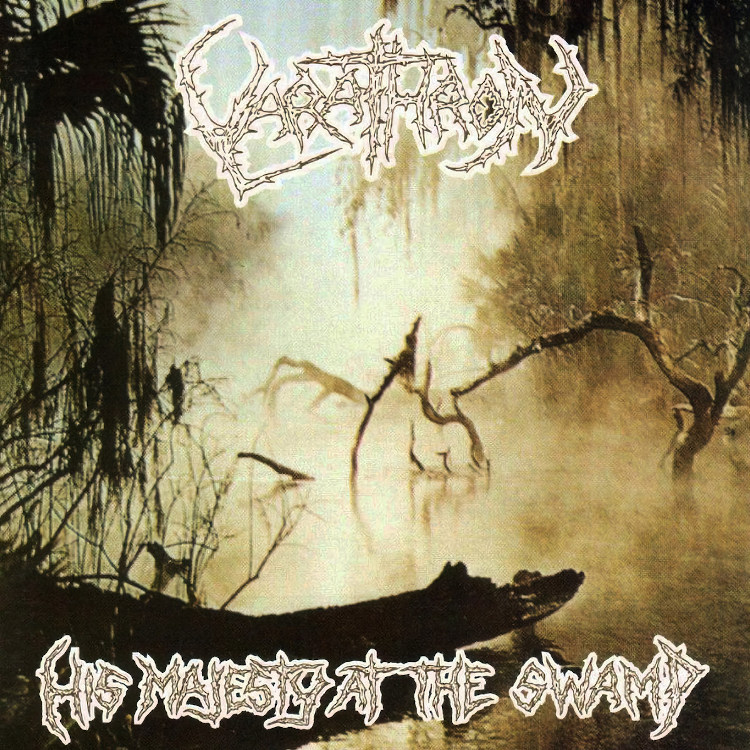
Varathron - His Majesty at the Swamp (1993)
Tempos rarely rise above a mid-paced stomp, giving this album the feel of Celtic Frost's "Procreation of the Wicked" or one of Iron Maiden's longer epics, and this album is full of harmonic minor single-string riffs. Also, do you guys remember when Dave Mustaine freaked out about sharing a bill with Rotting Christ and also had beef with Dissection? Hilarious.
Slowwwwwwwww.
Sunday, October 31, 2010
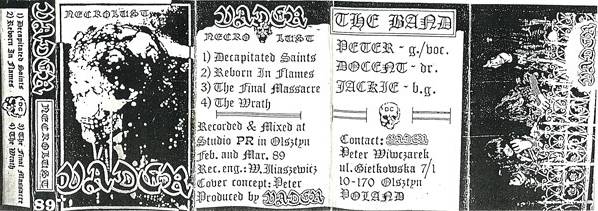
Vader - Necrolust Demo (1989)
That said, here is Vader's Necrolust demo, which exists in that late 80s extreme metal stew that I'm so obsessed with. This is really, really fast thrash metal with stupid production. I'm almost reminded of Massacra in the way that these hyper-speed riffs flirt with major tonalities and smoothly metamorphose into new themes. I have a fetish for this stuff.
*link removed*
Sunday, September 19, 2010
Like Rats - Like Rats (2010)
Sunday, August 29, 2010
Dream Death - Journey Into Mystery (1987)
This is a weird record that doesn't quite sound like anything else that I'm aware of from this time. It's quite a bit slower than other emerging death metal bands, and it mostly avoids the bluesy shuffles and overt Sabbath worship of other doom bands (except for the extended shuffle solo section in "The Elder Race"). The rhythmic emphasis typically lies on the beat, giving it a very methodical, plodding feel. If you are a frown-lover, this album will give you plenty of opportunity to frown. The drum performance is also impressive, which is important for a band with so much space in their songs.
Dan Polak, you know about this record, right? Because if you don't, I think it will be your favorite thing.
Friday, July 30, 2010
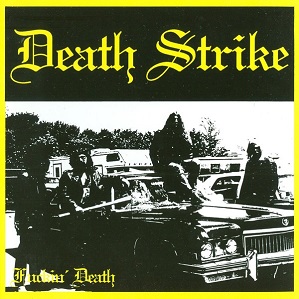
Death Strike - Fuckin Death (1985)
It should be obvious by now that I am a fan of primitive things. The absence of technicality reduces songs to an intuitive experience. "Does this work or not?" Although it is risky to strip things so bare, there is also potential for greatness in doing so. When it works, it really works. This is the zen meditation of proto-death metal. Let all riffs drift away until you're only left with power chords and Discharge-style drums. Acknowledge other thoughts, but let them pass into the abyss.
Labels:
*Hardcore,
*Metal,
1980s,
Death Strike
Sunday, May 16, 2010
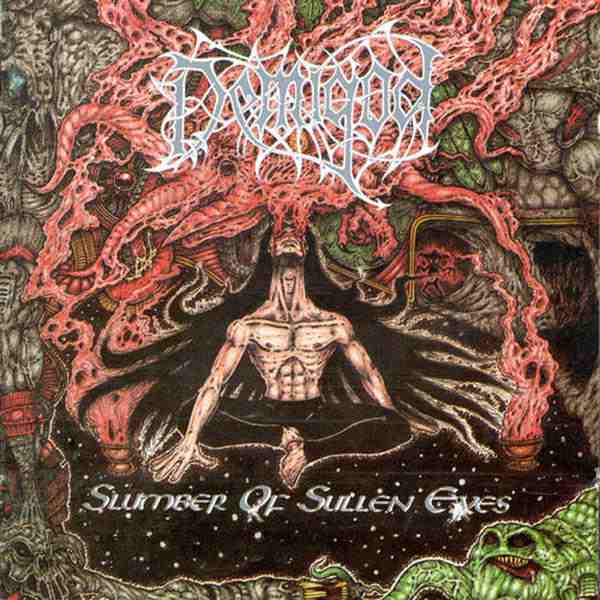
Demigod - The Slumber of Sullen Eyes (1992)
Demigod are willing to let a riff ride, which is a very admirable trait when riffs are good. This restraint is particularly admirable amongst riff-happy death metal bands. Phrases are often longer than the standard two measure melodic arc, and slight variations in percussion give motion. What a good way to write songs. Man although the one riff on the record that makes me go insane every time I hear it (the thirds with the backbeat about halfway through the title track) gets shorted a bit. Dang!
In conclusion, this Finnish band makes me think of sinking into a swamp more than any NOLA sludge ever has. A bog flows from my mouth, a bog flows from my mouth, a bog flows from my mouth.
Monday, April 26, 2010
War Cry - Trilogy of Terror Demo (1983)
Metal celebrity Paul Speckmann's (of Master & Death Strike duh) early work. While his later bands recorded some of the best primitive riffing of all time, this is Sabbath worship at its finest. Chicago metal, represent represent.
Later doom bands can plod, but they are not this heavy because their songs are boring. Later stoner bands know the pentatonic scale, but that riff factory is about worn out. This demo deserves to be mentioned in the same breath as Saint Vitus & Trouble.
Also, I'm a connoisseur of "ooh"s, and the one at the beginning of "Wicked Warlock" is fucking phenomenal. Nice and drawn out. It's also cool because it sounds like dude is pushing down on his floating bridge while chugging, so the pitch keeps wavering. Happy accident or genius subtle touch? Either way: WICKED WARLOCK! OOH!
Later doom bands can plod, but they are not this heavy because their songs are boring. Later stoner bands know the pentatonic scale, but that riff factory is about worn out. This demo deserves to be mentioned in the same breath as Saint Vitus & Trouble.
Also, I'm a connoisseur of "ooh"s, and the one at the beginning of "Wicked Warlock" is fucking phenomenal. Nice and drawn out. It's also cool because it sounds like dude is pushing down on his floating bridge while chugging, so the pitch keeps wavering. Happy accident or genius subtle touch? Either way: WICKED WARLOCK! OOH!
Tuesday, February 23, 2010
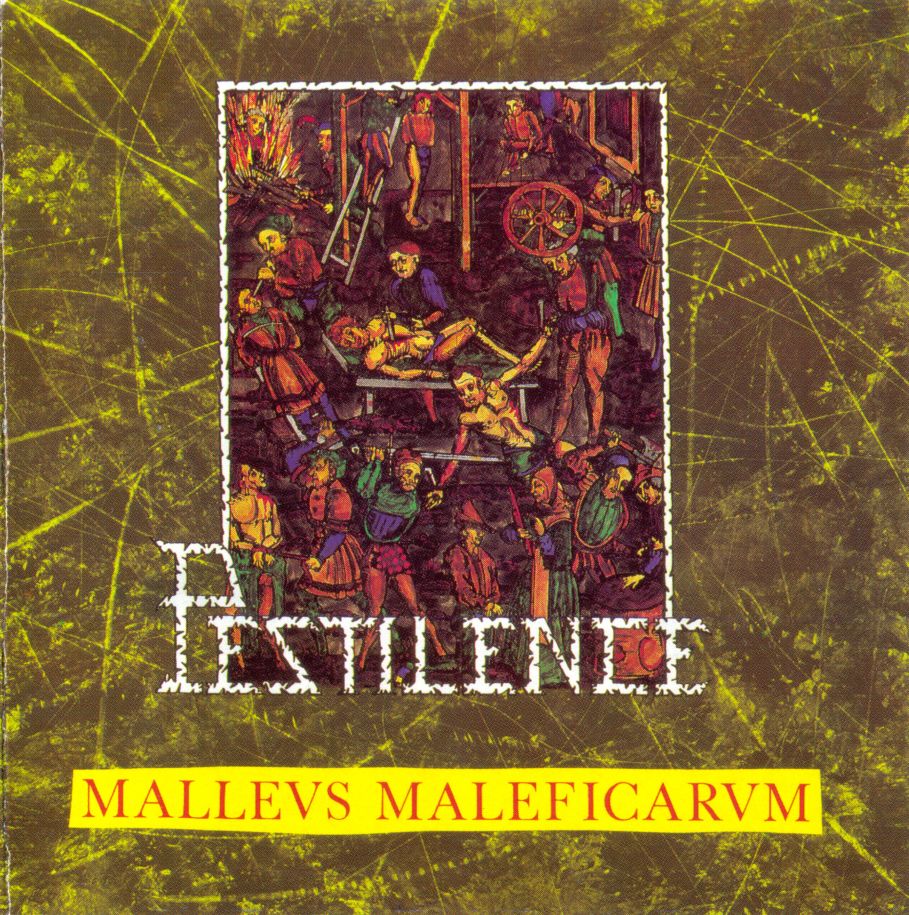
Pestilence - Malleus Maleficarum (1988)
Aesop posted something about not liking the transition between Slayer and Morbid Angel a little while ago over on Cosmic Hearse, but this is one of the stepping stones between thrash and death metal that is fucking gloriously excellent. There is an awful lot of palm-muting going on, and melodies have an awful lot of notes. At some level, I prefer the more distilled down, heavier material to come later, but there is something to be said for this fucking flurry. I can't even imagine recording the vocals on "Parricide." So many syllables.
Also, Pestilence use major thirds as a primary melodic vector, which is a sound that really grinds my goat off. (Megadeth and Merauder have also used this technique to great effect).
Monday, February 22, 2010
Morpheus Descends - Ritual of Infinity (1992)
Detuned power chord melodies swirl in sonic whirlpools before coalescing into an absolutely devastating riff that just completely blindsides you. See "Proclaimed Creator" for an example. This song gets my vote for having the most crushing death metal part ever recorded.
Also, the production is hilarious, and each kick drum hit does that weird volume swelling thing, which actually makes this a lot more primitive and heavy. Hey Andy, why does that happen again? Basically, I'm going to steal some of these ideas for Like Rats.
Saturday, January 9, 2010
Formicide - Demo I (1987)
A mid-paced thrash riff with cool syncopated emphasis is a beautiful thing, and as such, this demo tape is fucking beautiful. If you are into something like Nuclear Assault, then you are gonna want to download this. If you are a fan of playing a riff over a fast thrash beat, then dropping it to half time and switching the tremolo picking to down-picked palm muting, then you are gonna want to download this. If you sit around in a trailer camp listening to Anthrax, then you are gonna want to download this. Also, there are Halford wails.
Monday, October 26, 2009
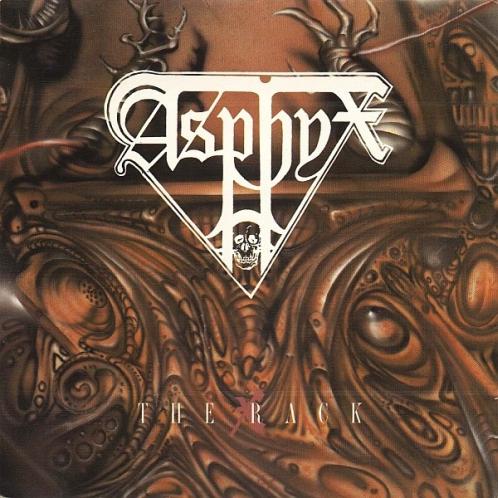
Asphyx - The Rack (1991)
I can remember the confusion I felt at these raw, sloppy European sounds that were recorded in an era that I thought was entirely dominated by grunge Q101 radio rock. The title of the intro track, "The Quest of Absurdity," immediately spoke to my existential pinings. Still, my initial reaction was "these guys are just playing power chords and they're not even that good at their instruments." I kept checking in, though, and, probably around the time that I "got" Darkthrone, I "got" Asphyx, and the towering monolithic structures created by guys sloppily playing power chords permanently cast a shadow over my consciousness. Listen to the outro riff on "The Rack" until this makes sense to you, too.
Wednesday, July 29, 2009
Like Rats - Like Rats (2009)

So, I have this platform on the internet where people are interested in my opinion on music. As such, I've got to take this opportunity to tell you to listen to my own recordings. Besides, I wouldn't post it if I didn't think you'd like it. Half-hearted apologies to all of my friends on Twitter/F-book who've already been informed of this a few times. You'll be fine.
This is basically an example of me writing music that I want to hear, and what I want to hear is chromatic riffs at mid-paced tempos, but sometimes fast and sometimes slow. I love Tom G Warrior's signature riff composition style, and I tried to write riffs that evoke similar feelings without actually copying his techniques. There are a few self-imposed stylistic restrictions in order to keep the overall aesthetic within certain boundaries: no palm-muting, no double bass drum. Special attention was paid to the way that two primitive riffs compliment each other and create a relationship that makes each one significantly more interesting than if it were to exist on its own.
With love from me to you:
While I'm talking about heavy Chicago bands, I also have to mention The Muzzler (Voivod, Morbid Angel, etc.) and Hate (newer Converge, except higher, more metal, and more pissed), both of whom recently put out new releases. The thing about these bands is that I would like them and listen to them even if I didn't even know them as people.
This is basically an example of me writing music that I want to hear, and what I want to hear is chromatic riffs at mid-paced tempos, but sometimes fast and sometimes slow. I love Tom G Warrior's signature riff composition style, and I tried to write riffs that evoke similar feelings without actually copying his techniques. There are a few self-imposed stylistic restrictions in order to keep the overall aesthetic within certain boundaries: no palm-muting, no double bass drum. Special attention was paid to the way that two primitive riffs compliment each other and create a relationship that makes each one significantly more interesting than if it were to exist on its own.
With love from me to you:
While I'm talking about heavy Chicago bands, I also have to mention The Muzzler (Voivod, Morbid Angel, etc.) and Hate (newer Converge, except higher, more metal, and more pissed), both of whom recently put out new releases. The thing about these bands is that I would like them and listen to them even if I didn't even know them as people.
Monday, July 20, 2009
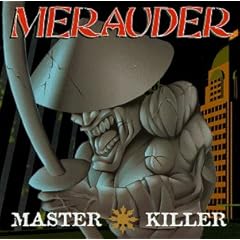
Merauder - Master Killer (1996)
This is death metal recontextualized as syncopated rock music. Nu-metal showed the world how guys with braids can do this in the worst possible way; Merauder showed the world how guys with braids can do this in a way that I like so much.
Merauder understands that the best way to make their listeners frown uncontrollably is to play at a steady, mid-paced tempo. There is some sort of evolutionary short circuit about heavy guitars with a backbeat at ~150 bpm that causes a severe frown reflex. Major thirds are prevalent, texturing riffs with a distinct flavor: Merauder's most recognizable moment, the big mosher at 1:57 in "Master Killer," makes use of this sound.*
You know, it's interesting that I like this record as much as I do, as the evolution of death metal and hardcore into stoogish w's downtuning their guitars and putting the kick drum on the "and" bums me the fuck out. However, sometimes it's just done really, really well. I am an adult, and this record regularly makes me see red and mosh in my bedroom.
*Please watch this whole video. Thank you have a nice day.
Subscribe to:
Posts (Atom)